
When You’ve Been Injured in an Accident, Knowing What Comes Next Matters
Car accidents are one of the most common causes of serious injuries in Delaware. In 2025 alone, Delaware recorded 27,682 reportable traffic crashes, including 4,963 injury crashes. More than 7,400 people were injured in crashes statewide.
Delaware State Police’s 2025 Annual Traffic Statistical Report recorded 7,477 injured people and 116 traffic fatalities statewide.
These crashes can lead to medical expenses, lost wages, long-term rehabilitation costs, transportation problems, reduced mobility, and disruptions to everyday life. If you were injured in a motor vehicle accident, understanding your rights under Delaware personal injury and automobile insurance law is essential.
Delaware drivers travel very different roads depending on where they live. A crash may happen in commuter traffic on I-95 or I-495 in New Castle County, along Route 13 in Kent County, or amid growing and seasonal traffic on Route 1 in Sussex County. Regardless of where an accident happens, injured people often face the same questions: Who pays the medical bills? What happens if I cannot work? What if the other driver says I caused the crash? What insurance coverage applies?
Rhoades & Morrow represents injured drivers, passengers, pedestrians, bicyclists, and families throughout Delaware, helping them understand those questions and pursue available insurance benefits and fair compensation.
Common Causes of Car Accidents in Delaware
Motor vehicle accidents occur for many reasons, but certain behaviors and conditions frequently contribute to collisions.
Delaware’s 2025 crash statistics identified driver inattention, distraction, or fatigue in 6,480 crashes. Following too closely was reported in 3,086 crashes, failure to yield in 2,589, improper passing or lane changes in 1,966, and careless or reckless driving in 1,652.
Common contributing factors include:
- Distracted driving, including mobile phone use
- Following too closely
- Speeding or aggressive driving
- Failure to yield at intersections
- Impaired or fatigued driving
- Unsafe lane changes or passing
- Disregarding traffic signals or stop signs
- Poor road conditions or inclement weather
- Mechanical failures or defective vehicle parts
- Heavy congestion on major roadways
Accidents can happen anywhere in Delaware, from rural roads to Wilmington’s urban streets and heavily traveled beach routes in Sussex County. Many incidents involve more than one contributing factor, and determining responsibility may require evidence beyond the initial police report.
Types of Vehicle Accidents in Delaware
While many collisions involve standard passenger vehicles, Delaware sees a wide variety of motor vehicle accidents. Each type presents different risks and insurance or liability issues. Rhoades & Morrow provides legal representation to injury victims in cases involving:
- Rear-End Collisions: These crashes often occur in traffic or at intersections and can cause neck, back, head, and other injuries.
- Side-Impact and Intersection Accidents: Failure to yield, traffic-signal violations, distracted driving, and unsafe turns can cause serious collisions. These car accident cases may require careful evaluation of right-of-way and fault.
- Highway and Multi-Vehicle Crashes: Collisions on high-speed roads such as I-95, I-495, Route 1, Route 13, and other major corridors may involve several drivers and insurance policies.
- Hit-and-Run Crashes: Delaware law requires drivers involved in qualifying collisions to stop. When a driver flees, uninsured motorist coverage may become particularly important.
- Drunk or Impaired Driving Accidents: Collisions caused by impaired drivers often result in severe injuries. The driver’s impairment may be critical evidence in establishing negligence and, depending on the facts, other legal issues may arise.
- Uninsured or Underinsured Motorist Accidents: When the responsible driver has no insurance or insufficient coverage for the injuries caused, an injured person’s own automobile policy may provide additional protection.
Delaware law defines certain hit-and-run vehicles as uninsured vehicles for purposes of UM coverage and requires insurers to offer additional coverage that includes underinsured bodily-injury protection.
Other Vehicle Accidents
Delaware also sees crashes involving larger commercial vehicles, motorcycles, bicycles, rideshare vehicles, delivery vehicles, and public transportation.
Collisions with large trucks may cause severe injuries because of the size and weight of the vehicles involved. Motorcycle and bicycle crashes leave riders with little physical protection, while commercial-vehicle cases may involve employers, contractors, vehicle owners, or additional insurance policies.
Pedestrian Accidents
Pedestrian accidents are another significant category of roadway injury in Delaware. Because pedestrians have little physical protection from a moving vehicle, these collisions can cause severe injuries.
In 2025, Delaware reported 191 pedestrian crashes, including 23 fatal crashes. Twenty-eight pedestrians were killed that year.
Pedestrians may be at risk:
- At intersections and crosswalks
- Along roads without sidewalks
- In parking lots and commercial areas
- Near schools, campuses, downtown districts, and transit stops
- Along beach and tourism corridors
- While navigating construction detours
Pedestrian claims can also involve disputes over visibility, right-of-way, speed, distraction, lighting conditions, and where the pedestrian entered the roadway.
Common Injuries in Delaware Car Accidents
An auto accident can cause a wide range of injuries, from temporary conditions to permanent impairments. We represent clients who have suffered:
- Traumatic brain injuries
- Broken bones
- Spinal cord injuries
- Neck and back injuries
- Internal bleeding or organ damage
- Soft tissue injuries
- Burns or lacerations
- Scarring and disfigurement
- Long-term physical pain
- Psychological trauma
Some physical injuries are immediately obvious. Others become more apparent in the hours or days after a collision. Seeking appropriate medical attention helps protect your health and creates documentation of your symptoms and treatment.
Many injured people face long recoveries that affect their ability to work, drive, care for family members, maintain their homes, or participate in activities they previously enjoyed.
Understanding Delaware Auto Insurance After an Accident
One of the most important parts of a Delaware car accident claim is determining which insurance coverage applies. An injured person may have more than one potential source of benefits or compensation.
Personal Injury Protection (PIP)
Delaware requires qualifying registered motor vehicles to carry Personal Injury Protection insurance, commonly called PIP or no-fault coverage.
Under 21 Del. C. § 2118, required PIP coverage includes qualifying reasonable and necessary expenses such as medical treatment, as well as net lost earnings and certain expenses for services the injured person would otherwise have performed.
PIP matters because these benefits may be available without first proving another driver caused the collision. This can help address medical expenses and lost income while a liability claim is still being investigated.
PIP benefits and a claim against an at-fault party are not necessarily the same thing. Understanding how the available policies work together can be especially important when injuries are serious.
Uninsured and Underinsured Motorist Coverage
Not every responsible driver has enough insurance to pay for the injuries they cause. Delaware automobile policies include uninsured motorist protection as required by statute, and insurers must offer additional coverage, including underinsured motorist protection, subject to § 3902.
This coverage can become important when:
- The other driver has no applicable liability insurance
- A hit-and-run driver cannot be identified
- The responsible driver’s liability limits are insufficient compared with the injured person’s damages
Our auto accident lawyers review available insurance policies rather than assuming the other driver’s policy is the only potential source of recovery.
Determining Liability Under Delaware Personal Injury Law
Liability depends on the circumstances of the collision. Responsible parties may include:
- The at-fault driver
- An employer responsible for a driver acting within the scope of employment
- A commercial vehicle owner or other responsible business
- Vehicle manufacturers in qualifying defect cases
- Other parties whose negligence contributed to the collision
Delaware’s Modified Comparative Negligence Rule
Delaware follows a modified comparative negligence system under 10 Del. C. § 8132.
An injured person may recover damages when their negligence is not greater than the negligence of the defendant or the combined negligence of multiple defendants. The damages are then reduced according to the injured person’s percentage of fault.
If the injured party’s negligence is greater than that of the defendant or combined defendants, recovery is barred.
For example, if a jury determines that an injured driver sustained $100,000 in damages but was 20% responsible for the collision, the award would generally be reduced by that 20% share of negligence.
Establishing fault may require analyzing:
- Police reports
- Witness statements
- Accident scene photographs and video
- Vehicle damage
- Traffic-camera or nearby surveillance footage when available
- Vehicle or electronic data when relevant
- Medical documentation
- Testimony concerning how the collision occurred
Rhoades & Morrow’s legal team has extensive experience evaluating these factors to help clients understand the strengths and weaknesses of their potential claims.
What to Do After a Car Accident in Delaware
What you should do after a car accident depends partly on where you are in the legal process. Maybe the crash just happened. Maybe you already exchanged information and filed an insurance claim. Or maybe several days have passed, and your injuries are becoming more serious than you first realized.
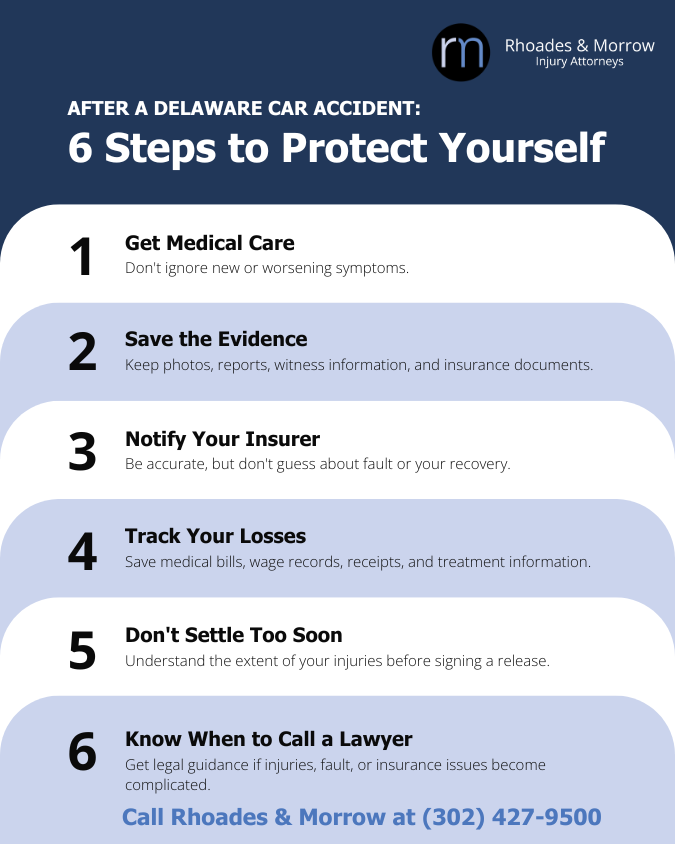
Wherever you are now, these steps can help protect your health and your legal rights:
- Get medical care if you are injured or developing new symptoms. Some injuries are obvious immediately, while others become more noticeable hours or days after a crash. Do not ignore worsening pain, headaches, dizziness, numbness, limited movement, or other concerning symptoms. Follow your doctor’s treatment recommendations and keep records of your care.
- Make sure the accident has been properly documented. If police responded, obtain the crash report when it becomes available. Keep any photographs, videos, witness information, insurance documents, repair estimates, and other records connected to the collision. If you did not take photos at the scene, you can still photograph vehicle damage and visible injuries afterward.
- Notify the appropriate insurance companies — but be careful about what you say. You may need to notify your own insurer even when another driver caused the crash. Give accurate information, but avoid guessing about fault, the extent of your injuries, or how quickly you expect to recover. You do not have to know the full medical impact of the accident immediately.
- Keep track of how the accident is affecting you. Save medical bills, receipts, wage-loss information, mileage or transportation expenses, and records of missed work. It can also help to document physical limitations and activities you cannot perform normally because of your injuries.
- Do not rush to settle before you understand your injuries. An early insurance offer may arrive before you know whether you need additional treatment, physical therapy, surgery, or time away from work. Once a personal injury claim is fully settled and released, you generally cannot return later simply because the injuries turned out to be more serious than expected.
- Get a free consultation with a Delaware car accident attorney if the claim is becoming complicated. Legal advice may be particularly useful if your injuries are significant, fault is disputed, you are missing work, the insurance company is questioning treatment, several vehicles or policies are involved, or you are simply unsure whether the settlement being discussed reflects the full effect of the accident.
You do not have to wait for an insurance dispute to become serious before asking questions. An experienced car accident attorney can review what has happened, identify available insurance coverage, and explain what steps may still matter.
How a Delaware Auto Accident Lawyer Can Help
When choosing a lawyer after a car accident, consider their experience handling Delaware personal injury cases and insurance claims, their communication, and their ability to litigate when necessary.
You should also expect straightforward advice. Not every disputed issue favors the injured person, and understanding both the strengths and potential challenges in a case allows clients to make better-informed decisions.
A Delaware car accident lawyer can help by:
- Investigating how the accident happened
- Identifying responsible parties
- Reviewing police reports, photos, video, and witness statements
- Identifying available liability, PIP, UM/UIM, and other applicable insurance coverage
- Assessing medical expenses, lost income, and long-term needs
- Documenting how an injury affects work and everyday life
- Preparing and presenting the claim
- Negotiating with insurance companies
- Representing you in litigation if needed
- Keeping you informed about the status of the case and what happens next
Rhoades & Morrow’s personal injury attorneys work directly with car accident victims and explain the process rather than expecting clients to understand Delaware’s insurance system on their own.
Most personal injury cases are generally handled on a contingency fee basis, with a written agreement that explains the applicable attorneys’ fees and case expenses before representation begins.
Compensation Available After a Car Accident
Depending on the facts of the case, fair compensation may address both financial losses and the personal effects of an injury.
Economic Damages
These may include:
- Medical expenses not otherwise satisfied by applicable insurance benefits
- Future medical costs for ongoing treatment and rehabilitation
- Lost wages
- Reduced earning capacity
- Property damage
- Out-of-pocket expenses
Non-Economic Damages
These may include:
- Physical pain and suffering
- Emotional distress
- Loss of enjoyment of life
- Physical limitations and loss of independence
- The impact a lasting injury has on normal daily activities
No fixed formula determines the value of pain and suffering in a Delaware car accident case. Evidence may include the nature of the injuries, treatment received, prognosis, duration of symptoms, physical limitations, and the effect on everyday life.
The Delaware personal injury attorneys at Rhoades & Morrow document the losses supported by the evidence and pursue the maximum compensation available under Delaware law.
How Long Do You Have to File a Delaware Car Accident Lawsuit?
Delaware’s general statute of limitations for any legal action seeking damages for personal injuries is two years from the date the injury was sustained. 10 Del. C. § 8119.
That does not mean every insurance or legal deadline is two years. Insurance policies, governmental claims, minors, particular defendants, and unusual circumstances can raise additional issues. The applicable deadline should be determined based on the specific claim rather than assumed.
Delaware Car Accident Claims Across All Three Counties
Rhoades & Morrow represents injured people throughout Delaware, including New Castle, Kent, and Sussex counties. Although driving conditions vary considerably across the state, serious car crashes occur in all three counties.
In 2025:
- New Castle County recorded 15,767 car crashes and 4,154 injured people
- Kent County recorded 4,698 car crashes and 1,353 injured people
- Sussex County recorded 7,217 car crashes and 1,970 injured people
From high-volume interstate and commuter crashes in northern Delaware to Route 13 collisions in central Delaware and Route 1/coastal traffic in Sussex County, our personal injury lawyers understand that the circumstances surrounding an accident depend heavily on where and how it happened.
Frequently Asked Questions
Talk With a Delaware Car Accident Lawyer
After a serious crash, you should not have to determine fault, insurance coverage, medical benefits, and legal deadlines by yourself.
Rhoades & Morrow represents injured people throughout Delaware. We will listen to what happened, explain how Delaware law and available insurance coverage may apply, and help you understand what to do next.
Contact us for a free initial consultation with a Delaware car accident lawyer. No upfront fees.